
The Duplication Tax: Why CrowdStrike Falcon EDR Customers Should Consider NG-SIEM
Many organisations understand the cost of cybersecurity software.
Far fewer understand the cost of moving the same security telemetry from one security platform to another.
This hidden cost can become significant.
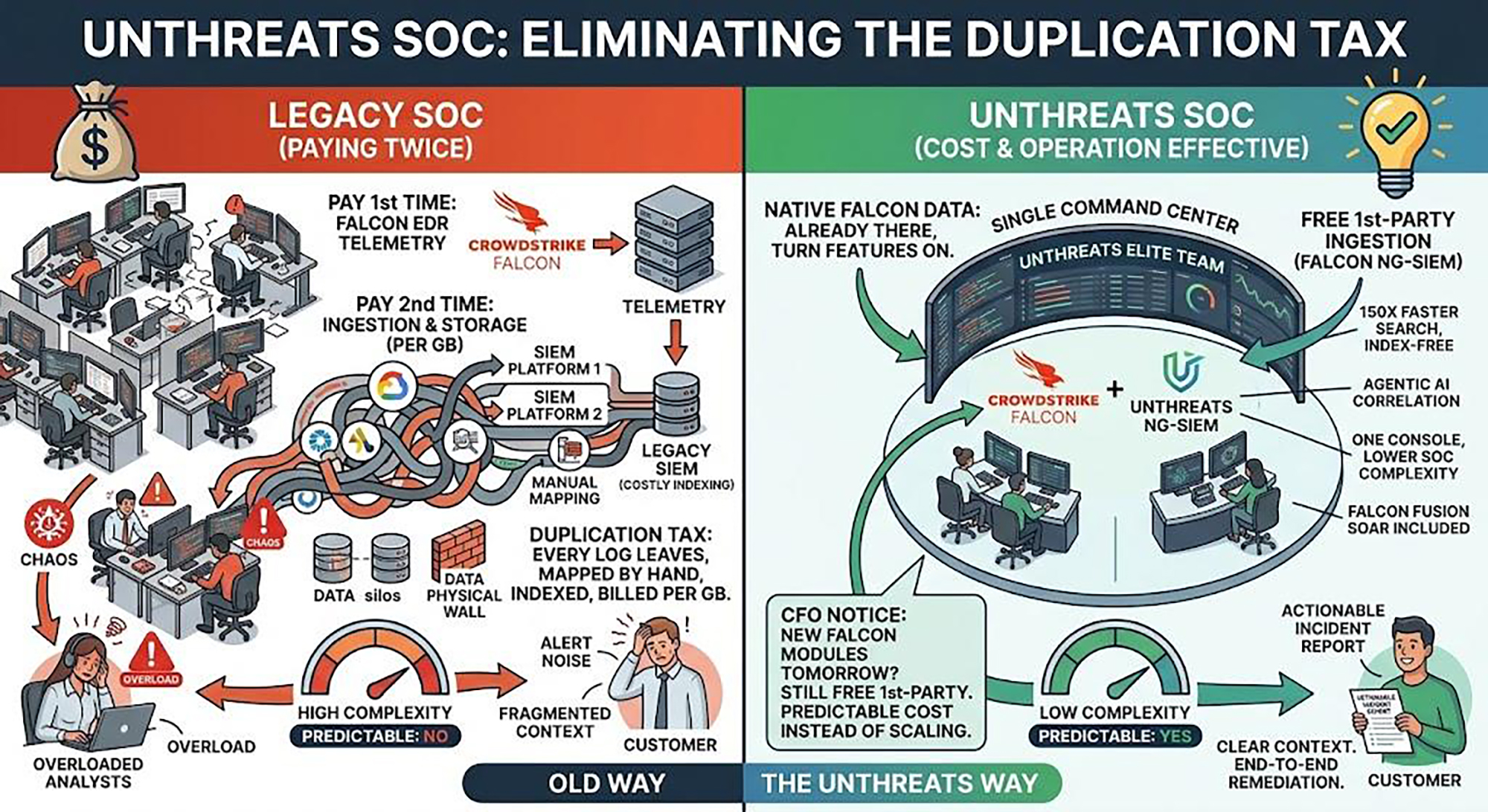
If your organisation is already running CrowdStrike Falcon EDR, your endpoints are already generating valuable security telemetry. Yet many organisations take that telemetry out of CrowdStrike, send it to a separate legacy SIEM, pay again for ingestion and storage, maintain complex log pipelines, perform manual data mapping and then pay again for the engineering effort required to keep everything running.
In other words:
You may already be paying for the security telemetry and then paying again to use it somewhere else.
This is what we call the SIEM duplication tax.
For organisations already invested in CrowdStrike Falcon, this is an important consideration when evaluating their next-generation SIEM strategy.
What Is the SIEM Duplication Tax?
Consider a typical security architecture.
Your organisation deploys CrowdStrike Falcon EDR across its endpoints.
Falcon generates rich endpoint telemetry containing information about processes, users, network connections, detections and other security activities.
Instead of using that data natively within the CrowdStrike platform, the organisation forwards the telemetry to a separate SIEM.
The process can look like this:
Falcon Sensor → Telemetry → Log Pipeline → SIEM Ingestion → Indexing → Storage → Detection Rules → SOC Investigation
Every step introduces additional cost and operational complexity.
You may have to pay for:
- Log ingestion
- Data storage
- Data indexing
- SIEM capacity
- Data transfer
- Log parsing
- Data mapping
- Detection engineering
- SIEM administration
- Infrastructure and operational resources
And the more telemetry you generate, the more the cost can increase.
This is the duplication tax.
You are effectively taking security telemetry that already exists within your CrowdStrike environment and building another expensive pipeline around it.
If You Already Run Falcon EDR, You Are Already Paying for the Telemetry
This is the question we believe every CrowdStrike customer should ask:
“If I already have CrowdStrike Falcon EDR, why am I moving my Falcon telemetry out to another SIEM and paying to ingest and store it again?”
This is particularly important as organisations increase their security coverage.
Today, you may only have endpoint telemetry.
Tomorrow, you may add identity protection, cloud security, vulnerability data, threat intelligence or other security capabilities.
With a traditional SIEM architecture, every additional source can potentially mean:
More data → More ingestion → More indexing → More storage → More cost → More engineering
The SIEM becomes increasingly expensive as your security environment grows.
Enter CrowdStrike Falcon NG-SIEM
This is where CrowdStrike Falcon NG-SIEM changes the architecture.
Instead of treating Falcon telemetry as another external log source that needs to be extracted, transformed and ingested, NG-SIEM is designed to work with native CrowdStrike data.
For existing CrowdStrike customers, this creates a fundamentally different approach.
Native Falcon Data
Your Falcon telemetry is already within the CrowdStrike ecosystem.
Rather than building another complicated pipeline to move the data into a separate SIEM, NG-SIEM can use the native Falcon data already available within the platform.
First-Party Ingestion
For CrowdStrike first-party data, ingestion into NG-SIEM is designed to avoid the traditional per-GB ingestion model associated with many legacy SIEM architectures.
That can be particularly attractive for organisations that already have significant Falcon deployment.
No Traditional Migration Exercise
Moving from a legacy SIEM does not necessarily mean rebuilding your security architecture from scratch.
With Falcon NG-SIEM, organisations can take advantage of the data already available within the CrowdStrike platform rather than treating Falcon as just another external log source.
No More Paying Twice for the Same Telemetry
The economic difference can be illustrated simply.
Traditional SIEM Architecture
CrowdStrike Falcon
↓
Generate Endpoint Telemetry
↓
Export Telemetry
↓
Log Forwarder / Pipeline
↓
SIEM Ingestion
↓
Indexing
↓
Storage
↓
Detection & Investigation
Every stage can introduce cost and operational overhead.
CrowdStrike NG-SIEM Approach
CrowdStrike Falcon
↓
Native Falcon Data
↓
Falcon NG-SIEM
↓
Detection + Investigation + Correlation + Response
The architecture becomes significantly more streamlined.
The objective is not merely to replace one SIEM with another.
It is to eliminate unnecessary duplication.
The Hidden Cost Isn’t Just the SIEM Bill
When organisations calculate the cost of a SIEM, they often look at the subscription or ingestion cost.
But that is only part of the equation.
There is also the engineering tax.
Someone needs to maintain the data pipeline.
Someone needs to configure parsers.
Someone needs to map fields.
Someone needs to troubleshoot ingestion failures.
Someone needs to maintain detection rules.
Someone needs to manage indexes.
Someone needs to investigate why data is missing.
Someone needs to tune the platform when the environment changes.
Over time, these activities consume significant engineering resources.
Therefore, the real cost of a legacy SIEM can be:
Platform Cost + Ingestion Cost + Storage Cost + Engineering Cost + Operational Complexity
This is why the cheapest SIEM subscription is not necessarily the cheapest security architecture.
No Manual Mapping for Native Falcon Telemetry
Another major operational advantage is the reduction of manual data engineering.
Traditional SIEM deployments often require security teams to normalise and map data from different security products into a common schema.
This is necessary because every vendor may structure its telemetry differently.
When Falcon data is natively available within the CrowdStrike platform, the SOC does not need to treat it like an unknown third-party log source.
The telemetry can arrive with its existing security context and enrichment.
This allows security analysts to spend less time worrying about:
“How do I make this data usable?”
and more time asking:
“What is this data telling me about the threat?”
Faster Search Without Traditional Indexing
CrowdStrike also positions Falcon NG-SIEM around high-performance, index-free search capabilities, with search performance marketed as up to 150× faster than legacy SIEM approaches in applicable scenarios.
The significance is not simply the number.
It is what faster investigation means operationally.
When investigating an incident, analysts may need to search across large volumes of security telemetry to understand:
- What happened?
- When did it happen?
- Which user was involved?
- Which endpoint was affected?
- What process executed?
- What network connections were established?
- Were other systems involved?
- Did the attacker move laterally?
- Are there related indicators elsewhere?
The faster the SOC can interrogate the data, the faster it can build the incident picture.
For an MXDR operation, investigation speed can directly influence the efficiency of incident response.
One Console. Lower SOC Complexity.
There is another important consideration.
Security operations become complicated when analysts need to jump between multiple platforms.
One console for endpoint detection.
Another for SIEM.
Another for identity.
Another for threat intelligence.
Another for SOAR.
Another for cloud security.
Another for investigation.
This creates context switching.
CrowdStrike’s platform approach is designed to bring security capabilities together within a unified ecosystem.
For an MSSP such as UnThreats, this has operational significance.
Our MXDR service is built around CrowdStrike technology, with Falcon NG-SIEM playing a key role in our SOC operations.
The objective is to give our analysts a more consistent operating environment for:
Detection → Investigation → Threat Hunting → Correlation → Response → Reporting
And with Falcon Fusion SOAR, automation can be incorporated into response workflows to reduce repetitive manual activities.
The CFO Will Ask a Different Question
The cybersecurity team may look at NG-SIEM from a technical perspective.
The CFO will probably look at it differently.
The CFO may ask:
“How much is this going to cost as our security environment grows?”
This is an important question.
Consider a company that already has thousands of Falcon-protected endpoints.
Tomorrow, the organisation activates additional CrowdStrike capabilities.
The traditional question is:
“How much additional data will this generate, and how much more will our SIEM cost?”
With native first-party data in Falcon NG-SIEM, the economic model can be more predictable because first-party CrowdStrike data does not follow the same duplicated third-party ingestion model.
This becomes increasingly important as organisations expand their security capabilities.
More security capability should not automatically mean a proportionate increase in SIEM ingestion costs.
A Simple Example
Imagine an organisation with 2,000 endpoints protected by CrowdStrike Falcon.
Those endpoints continuously generate security telemetry.
Under a traditional architecture:
Falcon → Export → SIEM → Ingest → Index → Store → Search
As telemetry volume increases, SIEM costs can increase accordingly.
Now imagine the organisation adds another CrowdStrike security capability.
More telemetry.
More ingestion.
More storage.
More cost.
More engineering.
With a native Falcon NG-SIEM approach:
Falcon → Native Data → NG-SIEM
The organisation can make greater use of the security data already available within the CrowdStrike ecosystem without unnecessarily duplicating the telemetry pipeline.
That is the architectural shift.
UnThreats: Making the Most of Your CrowdStrike Investment
UnThreats is an MSSP serving organisations in Singapore, Malaysia and the rest of the world providing MXDR services based on CrowdStrike technology.
We believe organisations that have already invested significantly in CrowdStrike Falcon should look carefully at how they are using their security telemetry.
If your organisation is already paying for Falcon, ask:
Why export the telemetry to another SIEM and pay again for ingestion and storage?
Why maintain another complex data pipeline?
Why spend valuable engineering resources manually mapping and maintaining security data?
Why operate multiple consoles when your SOC can work within a more integrated security ecosystem?
For customers considering a next-generation SIEM strategy, Falcon NG-SIEM provides an opportunity to simplify the architecture while making greater use of the CrowdStrike investment they already have.
From SIEM Cost to Security Value
The real benefit is not simply reducing the SIEM bill.
It is about reducing unnecessary duplication.
Reducing:
- Duplicate telemetry
- Duplicate ingestion
- Duplicate storage
- Duplicate engineering
- Duplicate operational effort
And ultimately:
- Duplicate cost.
A modern security architecture should make your existing security investment work harder, not force you to continuously replicate the same data across multiple platforms.
Stop Paying Twice for Your Security Telemetry
If your organisation is already running CrowdStrike Falcon EDR, your security telemetry is already one of your most valuable security assets.
The question is whether you want to:
Export it → Map it → Index it → Store it → Pay for it again
or take advantage of a more native approach with CrowdStrike Falcon NG-SIEM.
For organisations evaluating their SIEM strategy, the question is no longer simply:
“Which SIEM has the lowest price per GB?”
A better question is:
“Why am I paying per GB to ingest security telemetry that I already own within my security platform?”
That is the duplication tax.
And it is a tax that organisations should understand before committing to their next SIEM architecture.
Already running CrowdStrike Falcon?
Don’t pay twice for the telemetry you already have.
Talk to UnThreats about how our CrowdStrike-powered MXDR service and Falcon NG-SIEM can help simplify your SOC architecture, reduce operational complexity and get more value from your existing CrowdStrike investment.
UnThreats — Less duplication. Less complexity. More security value.